I am an ML/AI lead and research data scientist working on foundation models, probabilistic machine learning, and AI spatiotemporal modelling. I have an honours degree in experimental quantum computing, a doctorate in climate science, and more than six years of experience applying statistical and deep learning methods across research and industry.

I currently work across CounterCurrent and UNSW, building AI systems for ocean forecasting and maritime decision support while leading technical strategy, product development, and applied research.

In my spare time I like to ride bicycles, climb rocks and ferment food and drinks.

Interests
  • Probabilistic machine learning and generative artificial intelligence
  • Spatiotemporal modeling and timeseries forecasting in climate, remote sensing, energy, economics and finance
  • Reinforcement learning for optimization of complex systems
  • Techniques that combine AI, statistical modelling and physics
  • Bayesian modelling with stochastic variational inference
  • Quantum machine learning
Education
  • PhD in Climate Science, 2019

    Climate Change Research Centre, The University of New South Wales

  • Honours in Physics, 2012

    ARC Centre of Excellence for Quantum Computation and Communication Technology, The University of New South Wales

  • BSc (Adv.) in Physics, 2012

    School of Physics, The University of New South Wales

Selected Projects

CounterCurrent
As ML/AI Lead at CounterCurrent, I have driven development of two core products: Hydra, the company’s AI ocean forecasting system, and Odysseus, its intelligent route-optimisation engine for maritime decision support. I have led Hydra almost end-to-end, including large-scale foundation forecasting models on AWS, modern generative modelling approaches for spatiotemporal forecasting, and AI-driven data assimilation, while also playing a major role in the wider product stack, including routing systems and the web application. Alongside technical development, I help shape the technical roadmap, supervise team members, contribute to grants and programs, and engage with customers and investors.
CounterCurrent
Improving Antarctic Sea Ice Detection with CubeSat GNSS-R
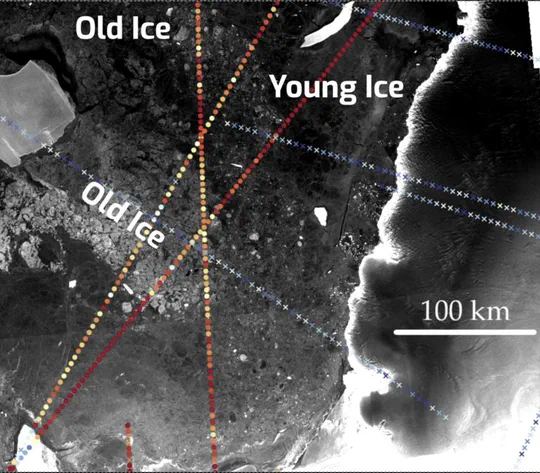
A novel application of passive GPS signals (GNSS-R) picked up by cube satellites to detect the location and age of Antarctic sea ice. A simple Bayes rule based update strategy has been implemented to improve estimates of various sea ice types using both a gradient boosting machine learning model and a robust mixture discriminent analysis statistical model as the likelihood.
Improving Antarctic Sea Ice Detection with CubeSat GNSS-R
Education and Outreach
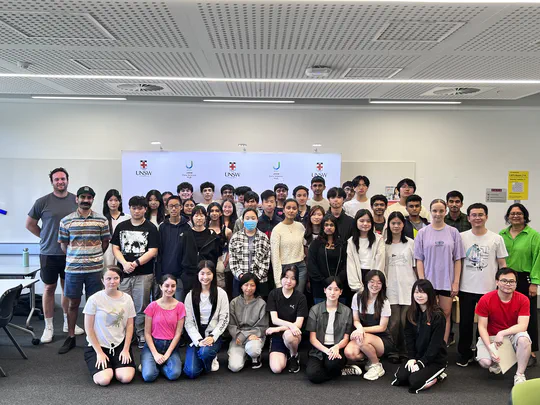
I am the lead academic on two key UNSW data science education and outreach initiatives. 1. The UNSW Data Science Hub Year 10 Work Experience Week, and 2. UNSW SciX Data Science Project. The work experience week is an intense five day annual workshop for year 10 students where they learn what it is like to be a data scientist. The SciX Data Science Project is a two week workshop and support program for year 12 students where they complete a science research project with a data science flavor over the course of a year as part of the HSC science extension curriculum.
Education and Outreach
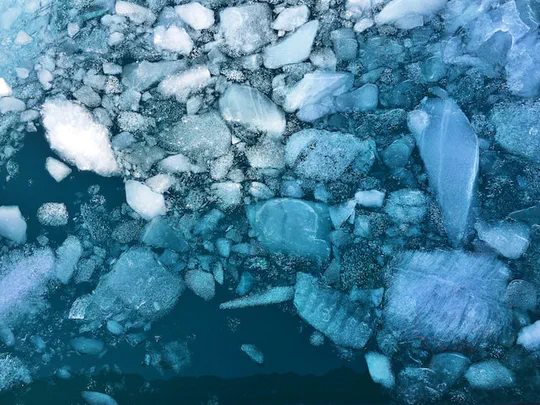
Sea Ice Segmentation

We use deep learning and computer vision to detect individual ice floes in aerial imagery with the aim to understand the frequency distribution of sea ice by their area.

Photo by Cassie Matias on Unsplash
Sea Ice Segmentation
Is It Hot Right Now?
Are temperatures in Australia right now anomalously warm or cold compared to the past? - A website that aims to demystify climate change by answering this question with simple visualisations and statistics. A personal initiative with fellow PhD colleagues Mat Lipson and James Goldie at the Climate Change Research Centre, UNSW."
Is It Hot Right Now?
Gap-filling of Ocean Temperature Timeseries
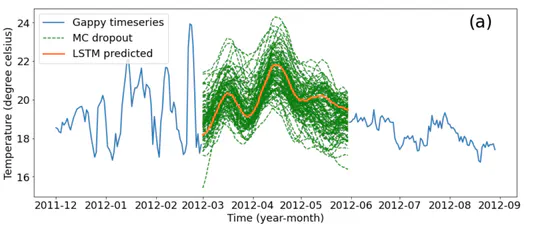
Probabilistic deep learning (bidirectional LSTMs) with monte-carlo dropout for filling up to three month long gaps in daily temperature observations around the Sydney harbour and the East coast of Australia. As part of a postdoctoral role in the UNSW coastal oceanography group, part of the Integrated Marine Observing System Australia.
Gap-filling of Ocean Temperature Timeseries

Contact

Feel free to get in touch via my socials or fill out the contact form below to send me an email.

  • UNSW Data Science Hub, Anita Lawrence Building H13, East Wing, Level 1, RC1050, UNSW Sydney, NSW 2052